TRANSMED (Pilot project)

Coordinator: Isabelle Taupier-Letage
Lab. d'Océanographie et de Biogéochimie (LOB), CNRS, Antenne de Toulon, La Seyne/mer, France
Fax: + 33 (0)4 94 87 83 07


Brief description of the project (pdf file - 4,9 Mo)

Project Summary:

TRANSMED aims, in fine, to develop a network of ships of opportunity for automated monitoring of the surface waters of the Mediterranean, using a complex of different physical, biogeochemical sensors*.

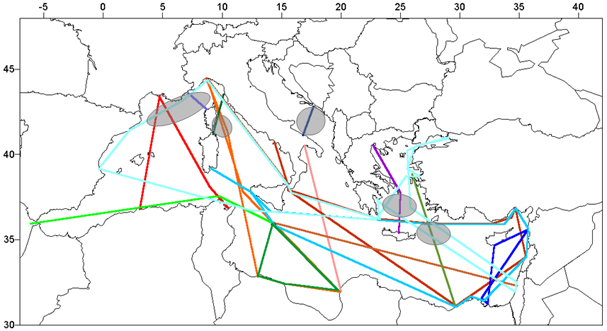
Figure 1 represents such an optimal network, based on existing shipping lines. It includes routes crossing the whole basins, sampling the dense water formation areas, and investigating poorly-known areas. Ferries are especially adequate, since they allow building time series with a relatively high temporal scale. Thus it is generally possible to correctly describe the mesoscale, which is present everywhere in the Mediterranean. Moreover a network allows a (quasi)synoptic view at the basin scale. Usually sub-sampled data are sent in real time (via Inmarsat), and contribute to operational oceanography.

Figure 1. Potential routes for further TRANSMED development.

The basic equipment is a thermosalinometer, which records the hydrological (temperature and salinity) parameters. Other instruments such as fluorometers (for phytoplankton chlorophyll determination) and biogeochemical sensors (for dissolved oxygen, pCO2, nutrients, etc.) can also be added, possibly completed by a meteorological station.

As a pilot phase, we installed, in March 2005 a SeaKeepers Module (thermosalinometer plus meteorological station) and a fluorometer on the SNCM car-ferry "Méditerranée", which crosses the whole western basin from Marseilles to Algeria and Tunisia, approximately once per week (Figure 2). Figure 3 illustrates the results obtained during the summer 2006 on the Marseilles - Tunis line: positive anomaly of temperature in July, negative in August in the northern part of the basin in particular it shows the very fast response to the setting of the mistral wind in late July 2006 in the Gulf of Lions, with the temperature dropping by 3-5°C within ~24 hours (upwelling).

Figure 2.

Figure 3.

The need/necessity to have an open, versatile and really autonomous system that would be simple and cheap appeared rapidly. CIESM fostered the development of such a prototype, realized by the Division Technique de l'INSU (<http://www.dt.insu.cnrs.fr/>) (Figures 4 and 5). Tests were conducted on the French RV Tethys 2, after the main functions of autonomy were implemented (commands of the pump, data acquisition and transmission). Once installed our TRANSMED protype performed satisfactorily as expected.

In the future the idea is to have part of the shipping lines equipped with the cost-efficient TRANSMED system (SBE45-based). For instance when there is no visibility on the route they are assigned to, or when maintenance is not expected to be easy , and to have the other shipping lines equipped with an improved TRANSMED system (SBE21-based),  that can accept additional sensors for multidisciplinarity.

Figure 4.

Figure 5.

_________________________________________

* For further details, on such systems, the interested reader may refer to <www.ferrybox.org> for example.

Cooperating agencies:

DT INSU, LOB/CNRS/Université de la Méditerranée, Région Provence Alpes Côte d'Azur, SeaKeepers, SNCM