CIESM JellyWatch Program
Monitoring jellyfish blooms along Mediterranean coasts
and in the open sea.
CIESM HQ support:
Annelyse Gastaldi
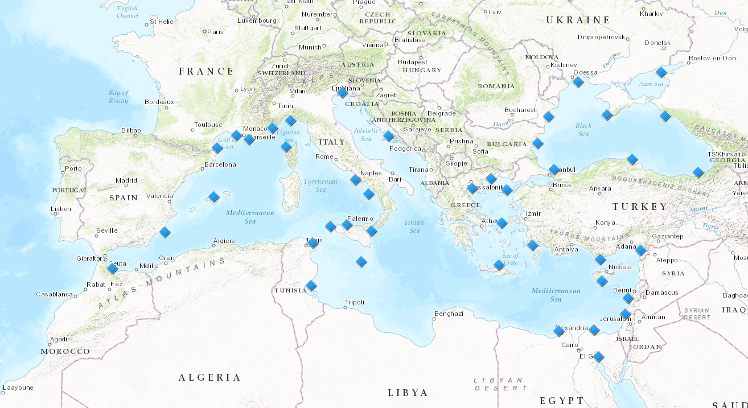
ACTIVE JELLYWATCH FOCAL POINTS
|
JELLYWATCH OPERATIONAL AREAS
- Bulgaria, northern coast, Dr Kremena Stefanova, Inst.Oceanology, BAS, Varna
- Cyprus, southern waters, Dr Yianna Samuel Roads, Univ. of Cyprus, Oceanographic center, Nicosia
- Dalmatian coast, Croatia, Dr Davor Lučić, Inst. Marine & Coastal Research, Univ. Dubrovnik
- Egypt, Suez Canal region, Dr Tarek Temraz, Univ. of Suez Canal
- France / Monaco, Cote d'Azur Annelyse Gastaldi, CIESM HeadQuarters
- France / Corse, Pierre Lejeune / Michèle Leduc, STARESO, Calvi
- France, Ile des Embiez, Dr Patrick Lelong, Institut océanographique Paul Ricard
- France, côte Vermeille, Renaud Vuillemin, OOB, Banyuls/s/mer
- Greece, northern Crete, Dr. Costas Dounas / Dr Yolanda Koulouri, IMBBC, Heraklion
- Greece, Cyclades, south Aegean, Dr Anastasia Miliou, Archipelagos Institute of Marine Conservation, Samos
- Greece, Gulfs of Thermaikos and Kavala, northeast Aegean, Dr Thanassis Tsikliras
- Israel, Dr Bella Galil, IOLR, Haifa
- Italy, Gulf of Genoa, Prof Luigi Pane/ Dr Guido Bonello / Dr Gian Luigi Mariottini, Univ. di Genova/ DISTAV
- Italy, Bay of Naples, Dr Raffaella Casotti, SZN
- Italy, Cilento coast, Fabio Barbieri, Capo Palinuro
- Italy, Sicily, Palermo area, Dr. Benedetto Sirchia, ARPA, Palermo
- Italy, Egadi Islands, Dr Stefano Donati, Egadi Islands MPA
- Italy, Sicily, Strait of Messina, Dr Letterio Guglielmo, Univ. Messina
- Italy, Gulf of Trieste, Dr Roberto Odorico, AMP Miramare
- Lebanon, south coast, Anthony Ouba, Centre National des Sciences Marines, Batroun
- Maltese waters, Dr Adriana Vella, Univ. of Malta
- Maroc, nord-ouest, Dr Mustapha Aksissou, Dept of Biology, Faculty of Science, Tétouan
- Crimean coast, , Dr Galina Finenko / Dr Boris Anninsky / Dr Natalya Datzyk, IBSS, Sevastopol
- Romanian coast, Dr Florin Timofte, Ntl Inst. Marine Res. & Dvt, Constanta
- Russia, Azov Sea east coast, Dr Inna Mirsoyan, Research Inst. on Azov Sea Fisheries, Rostov-on-Don
- Russia, NE Black Sea, Dr. Taisia Lukasheva / Dr Tamara Shignanova, Shirshov Institute
- Spain, Baleares, Dr Salud Deudero, Centro Oceanografico de Baleares, IEO, Palma de Mallorca
- Spain, southern waters, Dr Juan Eduardo Guillen, Litoral Ecology Institute, Alicante
- Tunisia, northern waters Dr Raouia Ghanem, INAT, Tunis
- Tunisia, Gulf of Gabes Dr Jamila Ben Souissi, INAT, Tunis
- Turkey, southeast Black Sea, Dr Rahşan Evren Mazlum, Univ. Recep Tayyip Erdoğan, Rize
- Turkey, Istanbul Strait, Tuğçe Gül, Tudav Foundation, Istanbul
- Turkey, Gökçeada island, northeast Aegean, Dr Onur Gönülal, Istanbul University
- Turkey, Bodrum region , Dr Nurçin Gülşahin, Faculty of Fisheries, Muğla University
- Turkey, eastern Anatolian coast, Ms Destan Öztürk, Marine Science Institute, Erdemli
- Ukraine, Gulf of Odessa, Prof Borys Aleksandrov, IBSS Odessa Branch
|
|
|
|
BACKGROUND
While jellyfish are a natural feature of the Mediterranean Sea, “jelly blooms” were rare episodes until the last eight years, when massive swarms of gelatinous organisms became a frequent sight in coastal waters. Such events represent a nuisance for swimmers, and in the case of certain species may become a real health hazard. They are considered a pest by fishermen, as they clog nets, keep away fish and consume fish larvae. In recent years, a number of industrial marine cooling systems had to be put temporarily out of order as jellies clogged the underwater pipes. The resulting socio-economic impacts – both direct (tourism) and indirect (coastal development, fisheries) – are thus tangible. From an ecosystem perspective, the apparent increase and synchrony of jellyfish outbreaks in both western and eastern Mediterranean basins are sending warning signals of a potential phase shift from a fish to a “gelatinous sea". Although overfishing, coastal habitat degradation and climate warming are amongst the most probable drivers, the specific causes and mechanisms are not well identified, and the lack of reference data makes any further investigation difficult.
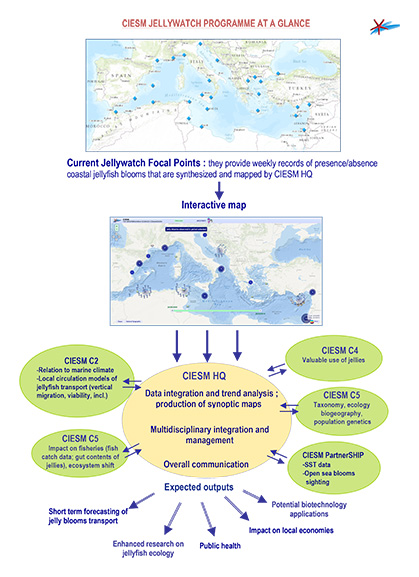
The CIESM Jelly Watch Program was set up to gather for the first time baseline data on the frequency and extent of jellyfish outbreaks across the Mediterranean Sea.
After a successfull pilot test phase involving a few countries, a common, standardized protocol including systematic recording of presence/absence data has been adopted for both coastal and open sea sightings of jellyfish swarms in the whole Basin, enabling an unbiased assessment of the geographic and temporal scale of these mass events so as to allow in time trend analysis and short term forecasting of jellyfish bloom transport.
|
|
UPDATE: Dec 2014 |
|